Active Sitting VII

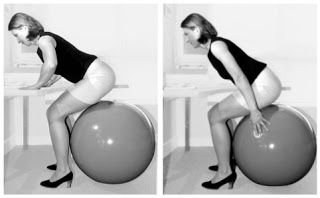
The following exercise will exercise your legs, stomach and back at the same time. Keep you stomach muscles tight throughout the exercise.

Squat

1. Have your knees at least shoulder width apart, place your ankles directly beneath your knees on the floor.
2. Place your hands on the edge of the table and lift your bottom of the ball, keeping the knees over the ankles.
• Repeat 3 to 5 times  

Variation for strength:
1. As before have your knees over your ankles and bring your upper body forward.
2. Place your hands on the outside of the ball next to your hips.
3. Bring your upper body forward until you are able to lift your bottom off the top of the ball. Check your knees are still above your ankles. Hold for 5 to 10 seconds.
• Repeat 3 to 5 times

Active Sitting Part VI

EXERCISES FOR THE LEGS

Many people don’t realise how important leg strength, flexibility and mobility are for the back. In order to be able to move in a back friendly way, we need to keep the legs strong and flexible. Prolonged sitting often results in shortened hamstrings. We therefore encourage you to stretch the hamstrings on a regular basis, too.

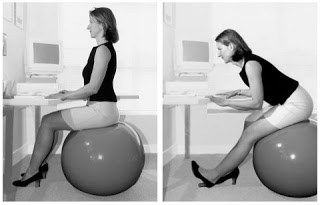
Hamstring Stretch

1. Straighten out one leg in front of you.
2. Hold onto the table.
3. Keeping the back straight, bring the chest towards the leg, lean forward with the upper body. You should feel a stretch in the hamstring of the straight leg. Hold this position for 10 seconds.
• Repeat stretch 3 times on each leg

Variation for Calf Muscles:
1. Repeat the previous exercise, but when you lean forwards towards the straight leg, pull the toes towards the shin. Feel how the stretch moves into the calf muscles.
• Repeat stretch 3 times on each leg

The following exercise will exercise your legs, stomach and back at the same time. Keep you stomach muscles tight throughout the exercise.

Squat
1. Have your knees at least shoulder width apart, place your ankles directly beneath your knees on the floor.
2. Place your hands on the edge of the table and lift your bottom of the ball, keeping the knees over the ankles. • Repeat 3 to 5 times

Variation for strength:
1. As before have your knees over your ankles and bring your upper body forward.
2. Place your hands on the outside of the ball next to your hips.
3. Bring your upper body forward until you are able to lift your bottom off the top of the ball. Check your knees are still above your ankles. Hold for 5 to 10 seconds.
• Repeat 3 to 5 times

Active Sitting Part V

In a previous post we looked at stretching the hip flexor. Today we will revisit this exercise but in a standing position.


Hip Flexor Stretch
1. Stand up and hold on to the table top.
2. Bend both knees slightly.
3. Standing on one leg lift other ankle onto the ball, keeping the knees together.
4. Keeping the standing leg slightly bent, straighten out the other leg over the ball and backwards. You should feel a stretch in the groin and thigh. Hold this position for 20-30 seconds.
• Repeat stretch on both sides

Active Sitting Part V

After a long break I welcome you all back to more infos and exercises on backcare and core stability exercises. 

In the previous posts you were introduced to simple stretching, mobility and strengthening exercises, please be sure to review the general guidelines about spinal movement before continuing with the next set of exercises.

Pelvic Mobility sideways

1. Keep the shoulders still and rest the wrists on the table while rolling the ball sideways.
2. Lift one cheek of your bottom of the ball while rolling sideways.
3. Roll the ball over to the other side.
• Repeat 10 times

Pelvic lifts sideways

1. As above roll the ball away to one side.
2. When lifting the pelvis up sideways, hold this position for about 5 to 10 seconds.
3. Change over to the other side. • Repeat 3 to 5 times on both sides
Variation for strength:


1. Start as above, lifting one side of the pelvis of the ball.
2. Let go of the table and reach with the arm/hand towards the ground on the side you are lifting the pelvis. Hold for 5 to 10 seconds and repeat on the other side.

Active Sitting Part IV

In the previous posts you were introduced to simple stretching, mobility and strengthening exercises, please be sure to review the general guidelines about spinal movement before continuing with the next set of exercises.

Stomach Exercises

1. Tighten the muscles in your stomach and bottom and hold these muscles tight throughout the exercise.
2. Start rolling the ball forward as you curve your back, moving your lower back towards the ball.
3. Bring your upper body back a little bit. Hold this position for 5 to 10 seconds while breathing normally.
• Repeat 3 to 5 times

Variation for strength:
To make above exercise more strenuous, you can let go of the table top and bring your hands to the shoulders. To push it even harder bring the hands behind the head and/or straighten the arms towards the ceiling. As before ensure you are breathing normally throughout the exercise.

• Repeat the exercise 3 to 5 times

Active Sitting Part III

Sitting Exercises

In the previous post you were introduced to two simple stretching and mobility exercises, please be sure to review the general guidelines about spinal movement before continuing with the next set of exercises.

Ear to Shoulder


1. Start with the head being upright, shoulders are back and your back is straight, rest your hands in your lap.
2. Drop your head away sideways, bringing the ear towards the shoulder. Make sure to keep the chin up. • Perform this 3 to 5 times on each side

Variation for a stretch:
In order to stretch the neck muscles while doing the above exercise, drop one hand down and let your arm hang along the body. Now drop the head away from this side towards the opposite shoulder. By pushing the hand towards the floor, you can increase the stretching feeling.
Again hold this position for about 10 seconds.
• Repeat 3 times on both sides

Shoulders

1. Push the shoulders forward, letting your hands rest in your lap and round the back a little.

2. Pull the shoulders back. Make sure not to arch the back. To insure a good spinal position, keep the tummy muscles tight.

3. Shrug the shoulders pulling them up to the ears as hard as you can. Hold this position for 3 seconds and then relax. Avoid holding your breath .
• Repeat 3 to 5 times

Variation for a stretch:
Repeat the above exercises 1 and 2, but hold the positions for about 10 seconds.
• Repeat these stretches 3 times

Look out for Active Sitting Part IV for more exercises.

Active Sitting Part II

Sitting Exercises

The following set of exercises will help you reduce the adverse effects of inactivity through prolonged sitting. They mobilize your joints, strengthen your musculature, stretch tight and tense muscles and increase your overall level of energy. The exercises are easily done and can be repeated frequently during the day. The more you engage in the simple routine the less likely you will suffer from the effects of continuous inactivity.

Spinal movements should be unilateral, the movement should only take place in one direction. We should for example avoid twisting and bending the spine at the same time. This applies to exercises as well as daily movements. Exercises or movements to ‘loosen up’ such as rolling the head can cause damage rather than being helpful and should be completely avoided.

Spinal movements should also avoid hyper-extension of the back, you should not curve the back backwards. Again, some exercises such as dropping the head back should therefore be avoided.

When exercising on the ball, sit upright and allow the spine to be in its natural curve and in good alignment. Breath normally during all exercises. Tighten the muscles in your stomach (simply pull your stomach in) as the musculature supports the lower back, stabilizes the hip and makes the exercise more effective. Hold on to the edge of the table or rest your wrists on the edge of the table, unless instructed otherwise.

EXERCISES FOR THE NECK & SHOULDERS:

Pigeon
1. Push the head forward, as far as possible, while keeping the shoulders back.
2. Pull the head back, keeping the chin down. Hold your head in this double chin position, then push it forward again.
• Repeat exercise 3 to 5 times

Variation for a stretch: Push the head forward as before. Then pull the head back and down again and hold this position for about 10 seconds, feeling a stretch in the back of the head and neck. • Repeat stretch 3 times

Head Turn
1. Keeping the shoulders straight and still and rest your hands in your lap.
2. Turn your head as far as possible, looking over your shoulder. Repeat on the other side. Compare the two sides and see if you have equal mobility when turning your head.
• Repeat 3 to 5 times

You will find Part III of the Active Sitting program in the next post.

Active Sitting Part I

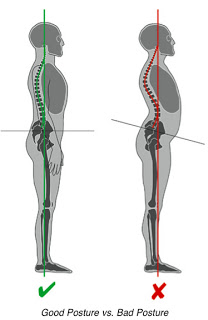
In a recent post we looked at sitting and how certain sitting positions can have an adverse effect on our spinal system. What does active sitting mean? In our active sitting program we introduce small exercises into our day. These exercises help us to loosen our muscles, to lubricate our joints and to strengthen and stretch our muscles to maintain a good posture. All exercises are done sitting on the ball. The ball on its own is a good way to keep the otherwise passive position of sitting relatively active. When sitting for a long period of time a good indicator of the state of our posture is our breathing. A posture which enables us to take a deep breath is naturally upright and in good spinal alignment. As we slouch our breathing becomes shallow and restricted, depriving us of one of our main sources of energy, oxygen. As the breathing is shallow the body accumulates high levels of carbon dioxide causing us to fatigue. Internal organs can be compressed and blood flow to these organs can be restricted, thereby reducing their functionality. Sitting upright enables us to breath more deeply allowing our body to work more efficiently.

Breathing Exercise:


1. Slowly take a deep breath and as your chest rises, feel how your thoracic vertebrae start straightening up without the conscious use of any other musculature such as your back muscles.
2. Exhale and let the shoulders, torso and chin fall down and forward a little. Repeat the exercise a few times.
We can enhance this simple exercise when sitting on the ball by gently rolling forward when inhaling and backward when exhaling. By rolling forward and back on the ball we mobilize the entire spine during this exercise. By simply focusing on our breathing we can thereby achieve an improvement in our sitting posture. Try to correct your posture in this way as often as possible during your working day. Allow your spine to be more upright, assuring good breathing and thereby increasing your energy levels.

Hip Flexor Stretch

This stretch is one of the most important stretches when it comes to backcare exercises.
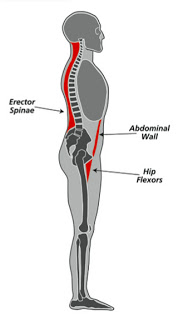
The hip flexors are very strong muscle group in the body, they tend to be very tight. They can be very short and exert a pull on to the pelvis tilting it forward, when the legs are straight. In a previous post we discussed the problems associated with this pelvis tilted forward.
Today we want to look at one exercise to stretch the hip flexors. Please review the general guidelines for exercises and stretching before you do this stretch.

  • Kneel on a mat, holding on to the ball in front of you.
  • Extend one leg forward, keeping your weight on the back leg.

  • Tilt your pelvis, by pulling your tummy in and tightening the muscles in your bottom, flattening the curve in your lower back.

  • The best way to describe this stretch is, imagine you are tucking your coccyx in.
  • Hold this position for about 20 to 30 seconds.

A few words on Stretching

Stretching describes those activities designed to increase the pliability and flexibility of a muscle. Stretching aims to increase a joint range of motion. In the past, many people engaged in ballistic stretches, stretches which were done in a bouncing manner. However, this type of stretching can trigger a reflexive contraction of the muscle thereby shortening the muscles or worse injure muscles tissue.

Stretching can reduce the tension in a muscles which can help to relax tight and tense muscles. Sometimes stretches are an essential part of a program to re-establish the balance between antagonistic muscle pairs. Stretching after intense activity can reduce the soreness in a muscle some people experience the day after exercising.

Stretching a muscles or muscles group on daily basis can improve the range of motion within a joint and thereby improve the flexibility. It is important to maintain good joint alignment during stretches to avoid damaging the joints themselves.

Before you start stretching it is a good idea to warm up just a little bit as this can make the stretching activity more effective.

Stretches should be done slowly and controlled. Gradually push into a stretch to feel a pulling sensation but no pain in the muscle. A muscle should never shake while stretching as this is a clear indicator for over stretching.

Hold a stretch for about 30 to 60 seconds. As you hold a stretch the pulling sensation can disappear. At that point you can intensify a stretch by pushing a little bit more.

In the next post we will look at the hip flexor stretch one of the most important stretches of any back care program.